Quantcast
Channel: The Thacker Chronicles
Viewing all 25 articles
Browse latest View live

The "Lost" 1800 Census of Louisa County, Virginia

$
0
0
Back in November, I posted the following on the Free Persons of Color Forum on the AfriGeneas website. I thought it might be of interest for those of you with Louisa County rootsTLS 


The loss of early census records for the state of Virginia has been a problem for all genealogists. Additionally, the 1810 census for Louisa County of Virginia, where my free colored ancestors lived is also missing.


According to the statistical compilation done for the 1790 census, there were only 14 individuals listed under the heading of “all other free persons,” for Louisa County. In 1800, the number had risen to 132.


In 1968, a copy of the 1800 census for Louisa County was found filed under tax records. The Louisa County Historical Society, printed a copy of the schedule in its magazine, “Louisa County Historical Magazine,” Volume 4, No. 2 dated June 1972. Another researcher sent me a copy for my records.


The gentleman who wrote the introduction to the article in the magazine, Ransom B. True, counted 12 households composed solely of free colored and 1 household that included a white female. He reported that no free colored owned slaves. However, according to the transcribed copy, a household headed by John Warren was composed of 2 Free Colored and 1 slave. I’m not sure if Mr. True missed this individual or if it was transcribed incorrectly.


The rest of the households composed exclusively of “other free persons” include the following:


Nathaniel Branham, 5 individuals

Ursala Cooper, 3

Patience Chase, 3

James Dowles, 3

William Dalton, 4

John Dalton, 12

Isaac Fuzzamore, 11

Duncan Homes, 3

Annis Lemay, 5

Thomas Mason, 6

Laurence Mason, 7

Francis Pack, 4


Additionally, there is the household of William Captain that includes 7 individuals listed as “other free persons,” and one white female that was of the age of 26 but not more than 45.


The remainder of the 132 listed under the column “other free persons,” are scattered among a number of families that are primarily white. It is difficult to know whether they were part of the family or merely servants. The largest group of these is part of the household of John Pointdexter Jr. That household is composed of 8 white males, 4 white females, 7 other free persons and 12 slaves.

Free White Names from the 1800 Louisa County Census

$
0
0
Below are some of the other heads of household named in the 1800 census for Louisa County, Virginia. I’ve chosen individuals who may or may not have something to do with our Vinton County Group.


You will notice that the Gibsons are all considered white by the 1800 census.

Bramham, Ludow

Free White Males

1 under 10 years

1 of 16 and under 26

1 of 26 and under 45

Free White Females


1 of 16 and under 26


Freeman, Robert

Free White Males

1 under 10

3 of 10 and under 16

1 of 26 and under 45

1 of 45 and upwards

Free White Females

2 of 16 and under 26

1 of 45 and upwards

1 Slave


Freeman, John

Free White Males

1 of 45 and upwards

Free White Females

1 of 16 and under 26

1 of 45 and upwards


Gibson, Gilbert

Free White Males

5 under 10

2 of 10 and under 16

1 of 26 and under 45

Free White Females

1 of 26 and under 45


Gibson, James P.

Free White Males


2 under 10

1 0f 26 and under 45

Free White Females

2 under 10

1 of 26 and under 45


Gibson, John

Free White Males

2 under 10

1 of 10 and under 16

1 of 16 and under 26

1 of 45 and upwards

Free White Females

3 under 10

1 of 10 and under 16

2 of 26 and under 45

4 Slaves


Gibson, Lightfoot

Free White Males

2 under 10

1 of 26 and under 45

Free White Females


2 under 10

1 of 10 and under 16

1 0f 26 and under 45

4 Slaves


Gibson, Thornton

Free White Males

1 of 16 and under 26

1 of 26 and under 45

Free White Females

2 of 10 and under 16

1 of 26 and under 45

2 Slaves


Gibson, William


Free White Males

2 under 10

1 of 26 and under 45

Free White Females

2 under 10

1 of 10 and under 16

1 of 26 and under 45

6 Slaves


Gibson, William SA (I’ve no idea what the SA means – anybody?)

Free White Males


4 under 10

1 of 45 and upwards

Free White Females

2 of 10 and under 16

1 of 26 and under 45

1 Slave


Lemay, Nancy

Free White Males


3 under 10

1 of 10 and under 16

1 of 16 and under 26

Free White Females

1 under 10

1 of 10 and under 16

1 of 16 and 26

1 of 26 and under 45


Napper, Ann

Free White Females

1 of 16 and under 26

1 of 45 and upwards


Napper, Thomas


Free White Males

1 of 26 and under 45

Free White Females

1 under 10

1 of 16 and under 26


Thacker, Alice

Free White Males

2 under 10

Free White Females

1 under 10

1 of 16 and under 26


Thacker, Isaac

Free White Males

1 of 16 and under 26

1 of 45 and upwards

Free White Females

1 of 26 and under 45

1 of 45 and upwards


Thacker, Jessee

Free White Males

3 under 10

2 of 10 and under 16

1 of 26 and under 45

Free White Females

4 under 10

1 of 26 and under 45


Thacker, Mary

Free White Males

2 under 10

Free White Females

3 under 10

3 of 16 and under 26

1 of 26 and under 45

1 of 45 and upwards


Thacker, Nathaniel

Free White Males

1 of 45 and upwards


Thacker, Reubin

Free White Males

1 of 26 and under 45

Free White Females

1 of 16 and under 26


Thacker, Reubin

Free White Males

1 of 26 and under 45

Free White Females

1 of 26 and under 45


Thacker, William

Free White Males

1 of 10 and under 16

1 of 26 and under 45

Free White Females

2 under 10

1 of 16 and under 26


No Daltons are listed as being Free White.  They are only listed under "Other Free Persons."

Reference:


True, Ransom B., “The Manuscript Return of the Census of 1800, ” Louisa County Historical Magazine, Louisa County Historical Society, Vol. 4, June 1972, 21-49.

Our Civil War Men

$
0
0
As you may know, I have been working on a list of those men affliliated with the Vinton County Group who enlisted during the Civil War.  I have already spotlighted the sons of Edwill Thacker (those in bold text below.) I am hoping to write a little about each of the men on this list.  It is difficult to know for certain who actually had ties to our clan, since by the time of the civil war, many had moved to other locations. 

Those highlighted in light orange are individuals that may or may not be related to the Vinton County Group.  If you see anyone on the list that you feel doesn't belong, be sure to write me.  If you feel I've left anyone out, please feel free to let me know. 

In addition to descriptions of all the men who enlisted in the USC, I also have descriptions for the following men: Ambrose Thacker, Nimrod Thacker, Chapman Thacker and Joseph Thacker.  If anyone has the descriptions for any of the other men, please let me know, so I can include that information when I write about those individuals.


  Last Nm, First Nm, Div, Branch, Unit, Company, Enlistment Date, Age, Birth YR


1 Shiflet Levi Ohio H.A. 1 H October 1, 1862 35 1827

2 Thacker George W. Ohio H.A. 1 B September 2, 1864 22 1842

3 Thacker Thomas B. Ohio H.A. 1 B September 1, 1864 21 1843

4 Thacker David Ohio Calv 12 F October 18, 1863 36 1827

5 Freeman John Ohio Inf 56 I November 7, 1861 NA NA

6 Thacker Fountain Ohio Inf 56 I & C November 7, 1861 24 1837

7 Thacker Joseph Ohio Inf 56 I October 31, 1861 26 1835

8 Thacker Henry Ohio Inf 73 G November 28, 1861 18 1843

9 Thacker David Ohio Inf 73 G November 21, 1861 34 1827

10 Thacker Robert W. Ohio Inf 185 E February 15, 1865 36 1829

11 Dorton Hiram Ohio Inf 194 D March 6, 1865 22 1843

12 Dorton James Ohio Inf 194 D February 14, 1865 29 1836

13 Napper John Ohio Inf 194 D March 6, 1865 18 1847

14 Napper Peter Ohio Inf 194 D February 18, 1865 36 1829

15 Thacker Chapman Ohio Inf 194 D March 6, 1865 43 1822

16 Thacker Ivory Ohio Inf 194 D March 7, 1865 42 1823

17 Thacker Nimrod Nicholas Ohio Inf 194 D March 6, 1865 42 1823

18 Thacker William H. Ohio Inf 194 D February 23, 1865 20 1845

19 Thacker John Ohio Inf 194 G March 3, 1865 20 1845


20 Thacker Lewis Ohio Inf 194 G March 3, 1865 44 1821

21 Thacker Ambrose Ohio Inf 198 C March 24, 1865 33 1831

22Napper John C. USC Inf 5 F August 16, 1864 24 1840

23 Napper Richard USC Inf 5 H June 21, 1863 41 1822

24 Napper William H. USC Inf 5 H June 17, 1863 21 1842

25 Thacker Charles USC Inf 5 H June 17, 1863 22 1841

26 Napper Alexander USC Inf 27 E February 12, 1864 24 1840

27 Thacker Ebenezer USC Inf 27 E February 27, 1864 20 1844

DNA, Genealogy, and Me

$
0
0
What I know about DNA could fit into a thimble.  But a couple of summers ago I was lamenting to my father that I could not find proof that my grandfather (the handsome fellow in the picture over to the right ) had been a Smathers before he was adopted.  I had anecdotal evidence that supported that our genetic surname was Smathers, but nothing more than that.  

My fear was that in another couple of generations, the story of how my father’s paternal aunts tracked him down would become one of those family tall tales.  My dad asked me if there was any way we could prove the connection.  In fact, I knew there was a way – DNA. 

I was aware that there was a Smothers/Smathers Family Tree DNA project and I knew that a descendent of Franklin Smathers, the brother of my great great grandfather Henry Smathers was one of the participants.  My dad looked at me and said, “Let’s do it.”  So we did.  

I won’t go into all the sleepless nights I had while we waited for the results.  What if the information I had wasn’t correct?  What if one of the earlier Smathers was adopted?  What if there was a child out of wedlock somewhere along the way?  What if – well, you get the idea.  A full quarter of my ancestry would be on the junk heap if there were no match, including my Thacker connection.  Oh boy, it was enough to make a girl sweat!  

Fortunately, when we got the results back,  my father’s DNA was a dead on match with the descendent of Franklin Smathers – 37 out of 37 markers.  (My dad’s DNA also matched those descending further up the line, so there was no adoption, nor any out of wedlock baby.)

Curiously enough, this would not be my only dip into the wonderful world of genetic testing. 

Recently, Ancestry.com sent me an invitation to become part of their autosomal DNA study that would look at my genetic ethnicity.  I had to reply by a certain date and agree to pay the shipping and handling fee of $9.95.  While the Y-DNA studies can only be done on males (because if you remember biology class only males have a Y chromosome which is passed on from father to son), autosomal  DNA can be done on both male and females.  In fact, two full siblings can have different results depending on what part of DNA they have inherited.  

Because my mixed heritage is so far back, I don’t have much faith that the test will show anything but European ancestry, but for the bargain price of $9.95 I was willing to play guinea pig! 

Maybe some of you Thacker, Dorton, Napper, Shiflett, Dole, and Freeman lurkers were also invited to participate.  If so, let me know and we can compare results!  

Or maybe, some of you have participated in other DNA testing and have interesting stories to share.  You can reach me by email.  The address is over on the right. 

Wouldn’t it be great if technology turns out to be the key to solving our family mystery? 

Update (Or Lack of Update) on Ancestry.com’s New Autosomal Test

$
0
0

In case anyone out there is burning up with curiosity on what’s happening with the Autosomal DNA test that I submitted to Ancestry.com the answer is – NOTHING (much.) 


On the first of March I received the below email from Ancestry letting me know that Beta testing would begin shortly.  Turns out it did begin, but only for a select group of people. 


When I emailed them after three weeks of waiting for “shortly” to begin, I got the stock answer that my sample was “in processing.” 

Trying to find more information out hasn’t been particularly easy.  However, CeCe Moore of the blog “YourGenetic Genealogist” has written several posts about this new product.  The latest post,“New Information onAncestry.com Ancestry.DNA Product,” is particularly interesting as it is a result of a phone conference that Ancestry held with several bloggers along with a private call she had made to the Ancestry.DNA team earlier. 

A couple of main points that interested me were: 

1.       1.  Of the current 22 ethnicities being tested for – Native American ethnicity is included.  This is good news for those of us who descend from the Vinton County Group.  (Although, because my own mixed race is so far back, it may not matter.)

2.     2.   North African ethnicity is also included but if I am understanding correctly that there is not yet a lot of detail in the African mixture as of yet.


33  3.   Because there is a reliance on information available on the family trees now on Ancestry for predicting ancestral origins, I am concerned that a lot of “bad genealogy” that I have seen on many trees, will lead  us astray. 

For example, if someone finds that he or she is a match with a Chapman Thacker descendent and in that descendant’s family tree it shows Chapman having been born in West Virginia (he was not!) that would send the “testee” looking in the area of West Virginia when he or she should be searching Louisa County, Virginia.

 4   4,   According to Ancestry.com officials, they said that they "will be getting it out to more and more customers throughout this year".    Which says to me, I could have a long wait to see the results.  Ah well, what can you expect when you are a Beta tester?

Ancestry Autosomal DNA Beta – The Saga Continues

$
0
0

Right before Easter, I received a notice from Ancestry telling me that they could not get a decent sample from the swabs that I sent to them last November.  The next day, April 5th, Ancestry sent me an email informing me that they had  sent a second kit for DNA sample collection.  

I still hadn’t received my kit by today’s mail, so I decided to call  Ancestry's DNA customer service.  

I learned a couple of things from Sean, my good buddy at Ancestry. 

1.      1.  They had a significant rate of problems with the swab tests. The new kits will contain a "spit" collection method instead of the swab collection method. ( I remember reading that another company does a spit method of collection.- Maybe 23 and ME?)

2.       2.  If the second kit is not here by May 6th, I can call and request them to send out yet another kit.

So, I’m back to square one.  ARGGHHH!!!!!

Good News, Bad News - The Results of My Ancestry Autosomal DNA Test

$
0
0
Okay, so the good news is I received the results from Ancestry's autosomal test.  The bad news is my results don't give us a clue to the Thacker clan's mixed racial identity.

I made a prediction of my own on what the results would look like. I predicted 73% Central European (I have German ancestors all over the place), 25% British Isles, and 2% Uncertain.

Below are the actual results.

So the thing is, I don't have a lick of Scandinavian heritage (Norway, Denmark and Sweden) in my family tree.   Ancestry, however explains it this way: 

For example, if you have German or British ancestors in your family tree, it’s a possibility that your genetic ethnicity may be partly Scandinavian. The Viking invasions and conquests about a thousand years ago are likely responsible for occurrences of Scandinavian ethnicity throughout other regions.

Okay, I can accept that. In addition, a quarter of my family tree came directly from the former German Province of Pomerania.  A portion of this province, known as the Hinterpommern, was in fact part of Sweden from 1630 to 1815.  This happens to be the exact area where this part of my family tree lived.

The Southern European is a bit of puzzler, however.  This area encompasses  Spain, Italy and Portugal.  I swear that I have not found one incidence of any of this ethnicity in my family tree.  It is interesting to note that many of the Melungeon's, (no, we are not Melungeons) a significant portion of whom trace their roots to Louisa County, have claimed that they descend from Portuguese sailors. 

A recent paper appearing in The Journal of Genetic Genealogy entitled, "Melungeons, A Multi-Ethnic Population" disputes this notion of a Portuguese heritage. The paper, co-written by Roberta J. Estes, Jack H. Goins, Penny Ferguson, and Janet Lewis Crain, is based on the testing of descendents of the Core Melungeon group.  They used YDNA tests (father to son) and mtDNA tests (mother to daughter ) to base their conclusions.  The findings of these test showed mostly a Northern European heritage with some African American origins and one Native American (the Sizemore's, who were NOT from Louisa County).

Still, these odd ball results of mine are food for thought.

I would be interested in hearing about the DNA results of anyone else who descends from the Nappers, Dortons and Thackers.  If you have had any testing done, please share.  You can either leave a comment or you can write me at the email address found on the left hand column of this page.  Maybe together, we can solve some of the mysteries surrounding The Vinton County Group.


“I don’t know nothin’ ‘bout understandin’ no DNA" - Autosomal DNA

$
0
0

When it comes to DNA, many of you, like me, might be scratching your head and saying (to paraphrase Prissie in Gone with the Wind), “I don’t know nothin’ ‘bout understandin’ no DNA.”  Boy, do I wish I would have taken time out from doodling and playing cootie catcher to listen to at least a couple of my science teachers. 

The University of Utah has put together four short little videos explaining the four kinds of DNA – Autosomal DNA, X Chromosome DNA, Y Chromosome DNA, and Mitochondrial DNA.  Currently, three of these types of DNA - Autosomal, YDNA and mtDNA (mitochondrial) are being used for genealogical purposes. 

The type of DNA that Ancestry used to predict my genetic ethnicity is autosomal.  If you are interested in understanding autosomal (a whole lot had better than yours truly could hope to explain) take a peak now at U of U’s autosomal DNA video.  

In a nutshell, each of us has 23 pairs of chromosomes.  Autosomal DNA looks at 22 of these pairs (the 23rd pair is the XY or XX chromosomes that determine a person’s sex.) 

You have inherited ½ your father’s autosomal chromosomes and ½ of your mother’s autosomal chromosomes.  But that also means that you lost half of each of your parents’ autosomal chromosomes. Likewise, your parents only inherited ½ of their parents’ autosomal chromosome etc.   

This is why your siblings’ genetic ethnicity might not look precisely the same as yours – they might have inherited different chunks of your parents’ DNA.  It’s also, why you and a cousin can take the test and not come up a match, yet you and a fourth cousin are.  It’s all in how the chromosomes recombined.

If you read the paper, “Melungeons, A Multi-Ethnic Population by Roberta J Estes, Jack H. Goins, Penny Ferguson and Janet Lewis Crain, you will see that the prediction of how much of the DNA I probably carry from my 4thgreat grandparents, Nimrod and Frances Thacker, is less than 1%.  If you factor in the probability that the individual who supplied the mixed race part of their DNA could have been 50, 100 or 200 years prior to their births – well, you can see why my autosomal DNA might not have picked it up.

For some of you who are descendants of the Vinton County Group, you may have expanded your chances by having several sets of the original group members.  Only testing will tell.  

Autosomal testing by Ancestry.com should be available to the US market some time later this year.  Family Tree DNA offers their own product called Family Finder and 23 and Me calls their product Relative Finder.


Note:  As of right now, Ancestry does not offer the option of looking at raw data, which the other products do.  

Announcing (I hope) The Vinton County DNA Project

$
0
0
Okay, this is a little premature, but I have applied to Family Tree DNA to do a geographic project for The Vinton County Group.  We will be looking at YDNA and mtDNA of the original members of the group trying to answer the following questions:

1. How are we related?
2. What is our ethnic background?
3. What is our genetic surnames?
4. Do we share common ancestors with any of the other so called triracial groups? 


Unfortunately, not all of us who descend from "the group: would have the "right stuff" to be tested. 

For the YDNA test you have to be male. You also have to have an unbroken father to son descent from the original members of the group, meaning you probably have the last name Thacker, Dorton or Napper. 

For the mtDNA testing it is a little trickier.  Mitochondrial DNA is pasted down from mother to child. A female child will pass it on to her children but a male child cannot.  So for example if my grandfather was alive (he is not), he could be tested because his mother was Elizabeth Cope Smathers.  Her mother was Frances Thacker Cope whose mother was Clarinda Thacker Marcum, whose mother was Frances Thacker Thacker. 

Frances is one of the individuals we want to find the mtDNA for, so while my grandfather would have Frances's mtDNA and would be a candidate for the test, his children would not.  However, one of my grandfather's sisters would not only be a candidate for the the test but so would her children. Have I confused you?

If you are interested in doing the test, but aren't sure if you qualify just email at the address in the right hand column of this page.  We'll chat. :)

Why am I telling you this now, before the project has been approved? Well,Family Tree DNA is having their summer sale from now through June 15th.  Below are the prices for New Kits.

New Kit Prices during the special:


New kits


Y-DNA12 : $59 instead of $99


Y-DNA37 : $129 instead of $149


Y-DNA67 : $199 instead of $238


mtFullSequence : $219 instead of $299


Family Finder : $199 instead of $289


Family Finder + Y-DNA37 : $328 instead of $438


Family Finder + mtDNAPlus : $328 instead of $438


SuperDNA : $428 instead of $518


Comprehensive (FF + FMS + Y-DNA67) : $617 instead of $797

The following are individuals whose YDNA we hope to find:

Nimrod Thacker
Holman Thacker
Chapman Thacker
Edwell Thacker
Ivory Thacker
Thomas Thacker
John A Thacker
Ellis Thacker
Robert Thacker
David Thackeer
Ambrose Thacker
George W. Thacker
Malachi Dorton
Levi Napper
Wetherfoot Napper
Peter Napper
William Napper (who may be Richard Napper)


The following are individuals whose mtDNA we hope to find:

Emma Jane Dorton, wife of Peter Napper, daughter of Mahala Thacker Dorton
Mildred Jane Thacker wife Wetherfoot Napper
Frances Thacker wife of Nimrod Thacker
Patsy Ann Thacker  wife of Levi Napper, Daughter of Sally Lemay Thacker
Permelia Jane Thacker wife of Joseph McKinnis and Levi Shiflet, Daughter of Sally Lemay Thacker
Peachy Thacker or Napper? wife of Moses Freeman
Martha Thacker wife of Chapman Thacker
Sally Thacker wife of Austin Pattison
Catherine Thacker wife James Jordon, Daugher of Nancy Dalton Thacker
Nancy Thacker wife of John Vest, Daughter of Nancy Dalton Thacker
Louisa Thacker wife of James Hollis, Daugher of Nancy Dalton Thacker
Polly Ann Napper, wife of Edwill Thacker, Daugher of Sally Napper (Gibson)
Roxanne Napper, wife of Holman Thacker, Daugher of Sally Napper (Gibson)
Lucinda Napper, wife of Sanford Smith, Daughter of Sally Napper (Gibson)
Virginia Napper, wife of James Dorton, Daughter of Sally Napper (Gibson)
Patsy Ann Napper, wife Ivory Thacker, Daughter of Sally Napper (Gibson)

Some of these are redundant.  For example Roxanne, Polly Ann, Lucinda, Virginia and Patsy Ann should all have the same mtDNA.  (But does Peachy?)

Theoretically all the Nappers should be the same and all of the Thackers should be the same, but are they?

Should we look for mtDNA for Sarah Evans wife George W. Thacker? What about Ann Vaughn wife of Thomas Thacker.  Should we include Moses Freeman or Levi Shiflet?

Lots of questions, and your input is wanted.  If you are interested, you can contact me through the comments or the email address over in the right hand column.  Maybe, together we will solve some of the mysteries.


WHY DO THE Y (DNA)?

$
0
0


While I am still waiting to hear back from Family Tree DNA, I thought now might be a good time to point out the benefit for the Vinton County Group in having YDNA tests done.  

NAPPERS

If you are one of the many descendants of Sally Napper aka Gibson, you know that there has been some speculation on the father of her children.  Many researchers believe the father was David Lemay, the son of John Lemay and Annis Branham Lemay.  

None of the researchers has shared their theory with me, but it definitely has merit. 

1.     1.  We find Sally and David Lemay living together in Vinton County in the 1850 census.

2.      2.    Richard Napper’s death certificate indicates that his father was a Napper and him mother was a Lemay.  It would be natural for the informant to mix the surnames of Richard’s parents or even the clerk taking down the information, since the natural assumption would be that the father’s surname would match the deceased. 

3.       3.  We know that by the 1800 census the Gibson’s were considered “white.”  So why were the Napper children considered Free Colored or mulatto?  It would follow that their father had to be nonwhite, and we know that John Lemay’s children with Annis Branham were considered nonwhite. 


So the benefit in an YDNA test would be the possibility of finding a genetic surname match.  There is not a current Lemay surname project at Family Tree DNA, but it would be still be possible that a Lemay was tested and is in the database.  If not, we could work at finding a willing Lemay participant to see if the Napper males match. 

Because there is no record of Sally Napper and David Lemay marrying, we can’t be sure that all of the children had the same father.  At the time, it was against the law for a white individual and a nonwhite individual to marry, so Sally and David could not marry regardless of how many children they had together. 

If we tested the DNA from the descendants from Wetherfoot Napper, Peter Napper, and Levi Napper and they all matched, it would not prove that all the children had the same father, but there would certainly be a much stronger case for this assumption. 

Finally, there is the matter of Richard Napper.  It is thought by some (me included) that the missing Uncle Dick from Lizzie Dorton’s recollection might actually be William Napper father of Irena Dolby’s children. 

One of Irena’s children lists Richard as the father on her death certificate.  If DNA of a descendant from William Napper matches, the DNA of the other three sons of Sally Napper that would go a long way in proving the theory that William Napper was a son of Sally and possibly the same individual as Richard Napper.

THACKER

Theoretically, all of the Thacker men should have, if not matching DNA, than a close match.  That of course, assumes that all of these men have the Thacker name through their father’s line and not their mother’s line.  It’s possible that some, or maybe even all, are not genetic Thackers but actually have different genetic surname.  The only way to tell is to have each of the descendants of the Thacker males tested.  Once that is done, we will have a better idea of the Thacker relationships. 

My hunch is you will find that they are a match for other surnames and not all of them match each other.  Since there are Gibson, Branham and Dalton surname projects it would not be surprising to see some matches to these groups.

DORTON

It’s clear if you look at Malachi’s census records that he had more than the three children ascribed to him and Mahala Thacker.  My hunch is if we test a descendant of James Dorton and some of the Thackers, we will find a match.

HAPLOGROUPS

Because the Y chromosome passes from father to son without recombining, it is possible to trace your ancestor’s migrations to a geographic region thousands of years ago.  So for example, when my father’s DNA was tested it showed that his Haplogroup R1b1a2.  

R1b1 is the most common Haplogroup found in Western Europe.  Because of migration patterns to the US, it is also the most common group in the US. 

The added designation of a2 on the end of my father’s group indicates that the group originated about 9500 years ago, and that the most prevalent ancient group was “European, Centum & Anatolian branches of Indo-European speakers”

Someone within my father’s surname project had additional testing done which further revealed R1b1a2a1a1b.  This group came into existence about 5300 years ago and was found in Western European and their ancient group was considered “Italo-Celtic.” 

So, fine, Terry, very nice, but what does it matter to me?  Well, when the YDNA is tested, we will get a Haplogroup listing for it.  This will give us another piece to our puzzle.  If for example, the test shows a Q Haplogroup that would indicate Native American Heritage. 

Thanks to theGibson surname project, those of us who descend from Gilbert Gibson know one  Haplogroup of a branch from our family tree.  

Someone from the group had further testing so that we know that Haplogroup for Gilbert Gibson and his descendants is R1b1a2a1a1b4.  That group formed about 4000 years ago.  They were found in Ireland, Britain, Northwest France, south-west Norway. 

Who in the Vinton County Group descends from Gilbert Gibson?  Anyone who descends from the following: 

1.      Sally Gibson aka Napper who was the daughter of William Gibson and Mary Adams Napper.  William was the son of George Gibson and Susannah unknown.  George was the son of Gilbert Gibson and first wife (name unknown.)

2.       David Lemay said to be the common law husband of Sally Gibson aka Napper.  David was the son of John Lemay and Annis Branham.  Annis was the daughter of Frances Gibson and Benjamin Branham.  Frances was the daughter of Gilbert Gibson and first wife (name unknown.)

3.      David Thacker, Robert Thacker, and Malachi (Dalton) Dorton who, according to a deed drawn in 1833, descend from Mary Branham Dalton.  Mary was the wife of  John Dalton and the sister of Annis Branham Lemay .  She descends from Frances Gibson Branham.

4.      Sally Lemay Thacker  who was the wife of David Thacker and sister of David Lemay.  She is, therefore, another descendent of Frances Gibson Branham.

What about the other Thackers of Vinton County?

 I don’t know the answer to that question but with YDNA testing, we may find the answer. 

There is a lot to be learned from YDNA testing.  If you are a father to son descendant from one of the Vinton County Thackers, Nappers or Dortons, please consider having the test done at FamilyTree DNA. 
Right now, there is a special going on until July 15. 

If you read this after that date and are interested in participating, please leave a comment or write to the email in the right hand column.  I will send you a notice the next time Family Tree has a sale. 


Note:  Information on R1b1 Haplogroups from Europedia.com 

It's Official - We Have A DNA Project!

$
0
0
Okay, it's pretty exciting - Family Tree DNA has given us the green light to go ahead with our Dual Geographic Project.  We have three participants already signed up!  All three are testing the mitochondrial DNA and are descendants of three different Thacker women.

There are other individuals who have expressed an interest in the project, but have not yet committed themselves to ordering a DNA kit.

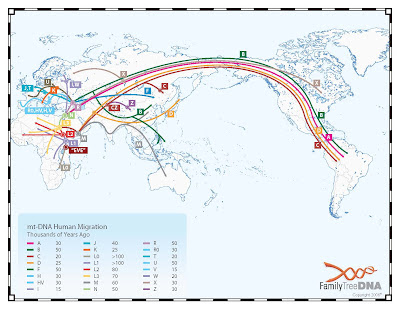
Just as testing of Y DNA can indicate the ancestral origins of an individual, so can mtDNA testing.  The map below from Family Tree DNA shows the various Haplogroups and their migration route.  Haplogroups A, B, C and D would indicate Native American origins.  The most common European mtDNA Haplogroup is H.


Paul Heinegg has theorized the Free Colored class came from the union of  Anglo-European females and African American males.  His theory has merit in that a child's status (either free or slave) was determined by the mother. In John Henderson Russell's book, The Free Negro in Virginia, 1619-1865, he makes a strong case that those African Americans brought in after 1640 were considered slaves.  It is, therefore, likely that the majority of African American females would have been slaves and any children born to them would also be considered slaves. If this is true, then our mtDNA probably will not confirm any African American heritage.


However, Dorothy A Mays in her book, Women in Early American: Struggle, Survival and Freedom in a New World, estimates that in colonial Virginia that there were 3.38 males for every 1 female, at times the ratio of male to female may have been higher.  It is not unreasonable to think that because of this some of the European males may have taken Native American women as mates.  Which is why testing of our mtDNA lines is essential.  While it is likely that our mtDNA will show as European there is a chance we might find the Native American link in a Vinton County Group's descendant  mtDNA.

Because all females descend from approximately 20 some Eves, and because mutations happen very slowly in the mitochondrial DNA, some have said that studying mtDNA for genealogical purposes is not useful.  Even with the full sequence panels that our three participants have ordered it still only tells us if they had the same female ancestress in the last 400 years. 

But in our overlapping families, if the results aren't a perfect match that will tell us that they are separate families, which will, if we are able to get enough descendants tested,  enable us to distinguish the various groups more readily.  Not to mention the information on the Haplogroups could prove to be interesting.

If you are interested in participating you can contact me at the email address in the right hand column.  You can now find our project listed at Family Tree DNA.  Look under Project, Dual Geographic, and the letter "V."  We are a small group so far, but it is a start.


Family Tree DNA Sale and DNA Results

$
0
0

Okay, if you have thought about getting your mtDNA tested or getting your very own Family Finder (autosomal) test taken, this is the weekend to do IT! 

I received the following notice from Family Tree DNA:

This sale starts Friday, September 28, at 12:00am and ends Sunday, September 30, at 11:59PM.

New Kits                   Current Price          SALE PRICE


Family Finder              $289                      $199

mtFullSequence           $299                      $199

Family Finder +
mtFullSequence           $559                      $398

Upgrades                Current Price         SALE PRICE

Family Finder              $289                      $199

HVR1 to
mtFullSequence           $269                      $199

HVR2 to
mtFullSequence          $239                       $199

mtFullSequence          $289                       $199


As with all promotions, orders need to be placed by the end of the sale and payment must be made by end of this sale.

Click here to learn more.


VINTON COUNTY GROUP DNA NEWS

In other news,  I suffered a hard drive crash last month.  I lost most of the genealogy files that I had neglected to back up in the last year.  I am still trying to regroup.  Thankfully, I had sent a copy of my Thacker ged.com to someone who has been a great help in understanding the ins and outs of DNA. 

Unfortunately, I was working on a post on Holman Thacker that I have to research again from scratch.  A descendant of Holman's took the YDNA test a few years ago when Ancestry was offering them. He has transferred the data to Family Tree and there was a match, but not to any Thacker's in the database. He has a 25 of 25 markers match to descendants of  - wait for it - Gilbert Gibson

More to come on this as I redue (groan) my research

We have the mtDNA results from the descendants of Mildred Jane Thacker wife of Wetherfoot Napper and Frances Thacker wife of Nimrod Nicholas Thacker.  Mildred is from the haplogroup H1c.  Frances is from the haplogroup U3a.   This means, though they were living beside each other in the 1850 census, they were not sisters.   More on this as I research these two haplogroups. 

Mitochondrial DNA Wanted for Vinton County Group DNA Project

Y DNA Wanted for Vinton County Group DNA Project

Family Tree DNA Sale!!!!!!!!

$
0
0
I received the following message fromFamily Tree DNA:


(My note: You can order  by clicking this link: LINK to Family Tree DNA page.)


As we ended our 8th Annual Genetic Genealogy Conference, several conference participants asked us to start our year-end sale as soon as possible. In answer to those requests we decided to start it immediately:


New Kits Current Price SALE PRICE/sale price is the one on the far right side.


Y-DNA 37 $169 $119

Y-DNA 67 $268 $199

mtDNAPlus $159 $139

mtFullSequence (FMS) $299 $199

SuperDNA (Y-DNA 67 and mtFullSequence) $548 $398

Family Finder $289 $199

Family Finder + mtDNAPlus $438 $318

Family Finder + mtFullSequence $559 $398

Family Finder + Y-DNA 37 $438 $318

Comprehensive (FF + FMS + Y-67) $837 $597


Upgrades Current Price SALE PRICE


Y-Refine 12-25 Marker $59 $35

Y-Refine 12-37 Marker $109 $69

Y-Refine 12-67 Marker $199 $148

Y-Refine 25-37 Marker $59 $35

Y-Refine 25-67 Marker $159 $114

Y-Refine 37-67 Marker $109 $79

Y-Refine 37-111 Marker $220 $188

Y-Refine 67-111 Marker $129 $109

mtHVR1toMega $269 $179

mtHVR2toMega $239 $179

mtFullSequence Add-on $289 $199


To order this special offer, log in to your personal page and click on the Order An Upgrade button in the upper right corner.


ALL ORDERS MUST BE PLACED AND PAID FOR BY MONDAY, DECEMBER 31, 2012 11:59:00 PM CST TO RECEIVE THE SALE PRICES.


My Autosomal DNA and Gedmatch

$
0
0

Okay, the truth is I’ve been meaning to write some posts about my experience with using Ancestry’s autosomal DNA test.  But whoa, new information keeps being tossed my way, and like the little pin ball in Monster Bash, I keep getting bounced from one thing to the next.  


You will recall that Ancestry had given my ethnicity as 42 % Scandinavian (What!), 38% British Isles and 20% Southern European (Double What!!).  Not what my paper trail in genealogy says, but hey, I’m not a scientist. 

One of the cool things Ancestry has done (after much pressure from the Genetic Genealogy segment of the Genealogist community) is to give us access to our raw data.  Which I promptly downloaded.  I even looked at it, for all the good, it did me.  Fortunately, for me, I have an engineer Internet genealogy buddy who is way too smart for his own good, and he could look at the data and tell me things like where he and I matched. He also was smart enough to practically drag me into putting the raw data on Gedmatch. 


Gedmatch is a wonderful site for “playing” with your DNA results.  You upload your information. (Their instructions were clear enough that even a non-techie like me could do it.) Then you wait.  I don’t know how long you wait because; quite frankly, at the time I didn’t really see the value of uploading the information.  It could be days.  It could be weeks.  But about a month later, I went back, logged in and I was ready to go.


Some cool things you can do.


1.       You can predict your eye color – They came pretty close to getting the dark gray blue color of my iris correct, the gray outer circle was also right, but missed slightly on the color surrounding my pupil.  Very cool!


2.        It can predict if your parents had ancestors in common – according to Gedmatch, there is a 0% chance that my mom and dad had a common ancestor.  I haven’t found anything to contradict this.


3.       You can get a list of matches from everybody who has entered their raw data into Gedmatch.  That means not only other Ancestry DNA alumni, but also those individuals from 23 and Me, and Family Tree DNA.  Think of the possibilities. 


4.       You can compare your matches to see on which chromosomes you match, and on exactly which part of that chromosome the match occurs.


5.       You can run programs predicting your admixture (ethnicity in Ancestry speak.)


6.       Other cool things too numerous to mention.  No, trust me; if you’ve wanted to let your inner Nerd go wild, this is the place!


It’s item number five, I want to talk about today, Admixture Gedmatch style.


There are four different individuals, genetic genealogists if you will, who have contributed various admixture calculators to the website.  Three of the individuals concentrate on studying European DNA, and there is a fourth individual who focuses on Middle Eastern and Asian DNA.  They use both DNA results that have been published elsewhere, plus they have recruited participants online to fill in the gaps. 


For example, Davidski (Polako) who runs the EurogenesGenetic Ancestry Project, has created several different calculators that you can run.  With the K36 calculator you can compare your DNA to 36 different “ancestral clusters.”  For his “Pygmy” category, he used DNA donations from the Mbuti and the Biaka peoples, to give you one example of the datasets he is using to compare my DNA data.


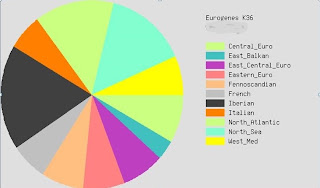
 Below are the results that I get when I run my own DNA using the K36 calculator.

Population
Amerindian
-    
Arabian
0.31%
Armenian
-    
Basque
0.84%
Central_African
-    
Central_Euro
8.28%
East_African
-    
East_Asian
-    
East_Balkan
3.36%
East_Central_Asian
-    
East_Central_Euro
7.49%
East_Med
-    
Eastern_Euro
7.44%
Fennoscandian
7.69%
French
6.32%
Iberian
18.14%
Indo-Chinese
-    
Italian
5.94%
Malayan
-    
Near_Eastern
-    
North_African
-    
North_Atlantic
14.12%
North_Caucasian
-    
North_Sea
14.59%
Northeast_African
-    
Oceanian
-    
Omotic
-    
Pygmy
-    
Siberian
-    
South_Asian
0.47%
South_Central_Asian
-    
South_Chinese
-    
Volga-Ural
-    
West_African
-    
West_Caucasian
0.71%
West_Med
4.30%

And below is the pretty little graphic that Gedmatch made for me:

Davidski says about this calculator:


An important point to keep in mind is not to take the ancestry proportions too literary. If you're, say, English, and you get an Iberian score of 12% this doesn't actually mean you have recent ancestry from Spain or Portugal. What it means is that 12% of your alleles look typical of the reference samples classified as Iberian, and this figure might only indicate recent Iberian admixture if it's clearly higher than those of other English users.”


He also says:


“The main purpose of the Eurogenes K36 is to help users unravel the ethnic origins of local areas of their genomes (aka. half-segments), hence the high number of ancestral categories, some of which are very specific. In other words, the test is mainly a chromosome painting utility.”


 So, okay, I shouldn’t take this all too literally.  And it’s more of a tool for chromosome painting.  Huh, you say.  What is chromosome painting? In this context, Chromosome painting is a way to look at the individual chromosomes to see what the various ethnicities look like graphically on that chromosome.  If you’re not following this, it’s okay.  In my next post, we will play show and tell to give you a better idea about chromosome painting.

Every Picture Tells a Story - Chromosome Painting

$
0
0


One of the things that has fascinated me right from the beginning was the mixed racial aspect of my Thacker branch of the family tree. But I am seven generations removed from David Thacker and his wife Sally Lemay Thacker.  Who knows how many generations the two of them were removed from their own non-European ancestors.


With each successive generation that married into European only families, my branch of the family lost all traces of their non-European heritage.  


So when the results of my DNA testing came back showing only European ethnicity I was not surprised – disappointed, yes, but not surprised. 


But what if lingering traces of my minority roots still remained in small segments? Segments so small that they didn’t show up in my overall ethnic mixture, but large enough to be recognized on the chromosomal level.  


That’s what the chromosomal painting features do at Gedmatch.  Simplified, your raw data is looked at and compared to the base data set, and based on those comparisons, the ethnicity of each segment of the chromosome is “painted” so you can “see” the different pieces of ethnic heritage.  


In my last post, I showed you my overall ethnic heritage according to Eurogenes K36 calculator.  Theoretically, I could use that same K36 calculator to paint my 22 pairs of chromosomes. The problems with doing that are twofold. 


1.    1.   It’s impossible for the computer to show 36 separate colors, and therefore the color red, for example, is used for Native American, Volga-Ural and Indo-Chinese.  Though  you can easily see red painted on a chromosome, you can’t be sure what the color means. 


2   2.  According to Gedmatch, there is a glitch in the program, and it can only paint up to 26 different ethnicities.  If you have a very diverse ethnic background, (over 26 of the listed ethnicities) you won’t get an accurate painting. 


So I picked Eurogene’s K12 to do my chromosome painting.  Here’s what is says about my overall admixture

South Asian                            1.00%
Caucasus                               2.98%
Southwest Asian                     2.60%
North American Indian &      
Artic 
Siberian
Mediterranean                        14.52%
East Asian                             
West African             
Volga-Ural                               8.63%
South Baltic                           15.43%
Western European                   28.41%


Here’s what the admixture looks like showing all 22 pairs of  painted chromosomes. 


The chromosomes are numbered left to right, and the segments run from bottom to top.  You can see that the majority of my chromosome are painted in the two hues of purple for Western European and North Sea.


My paternal grandmother’s family came to this country in 1906.  They came from a place called Pomerania, which is near the Baltic Sea.  Their contribution can clearly be seen in the deep blue portions of the painting. 

If my paternal grandfather had had his mitochondrial DNA tested, (he is a direct mitochondrial descendant from Frances J. Thacker) he like the other descendant of Frances J. Thacker we had tested, would have been found to have the U3a1 Haplogroup.  This particular haplogroup has its highest incidence in countries surrounding the Black Sea.  These countries would be found in the Caucasus, painted in Orange and the upper portion of the Southwest Asia area, painted in brown. 

But what I am really looking for are the American Indian segments (painted in Yellow) and the African segments (painted in mint green).  If I squint, I can make out a few tiny slivers of yellow and mint green on some of the chromosomes.  

My next post will take a look at these.


Interesting Article on Racial Origins of Melungeons and oh, yes - probably The Vinton County Group too!

$
0
0
One of my Internet friends (and also as it happens, a distant, distant, distant cousin) sent me a link to an article written in October of 2002 by a George R. Gibson entitled "Mellungeons and Myth."  The article, in fact, appeared in Appalachian Quarterly in December 2002.

It's a great piece looking at the possible racial origins of Melungeons. Since the Vinton County Group has the same Virginian Gibson heritage, the information relates to our own mixed racial origins. 

Mr. Gibson's conclusions after doing research, mirrors very closely to my own beliefs on the subject.

In any case, if you are enamored, like I am, with the idea of our mixed racial roots you might like to take a peek at this article.

You can find it HERE.


Thanks, J for forwarding this to me. :-)

New Ethnicity Estimates from Ancestry.com

$
0
0
You'll remember that when Ancestry came out with their predictions of my ancestry, I wasn't all that impressed.

Below is a look at what they said my ethnicity was:


Today, some lucky Ancestry DNA customers got a first glimpse at a program they will be rolling out for all of their DNA customers over the next few months.

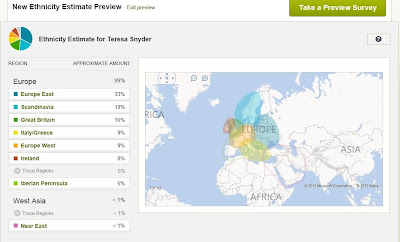
Count me as one of the lucky ones.  Below are the "new" ethnic predictions Ancestry has made for yours truly.


I'm still studying it, but I really do like the documentation and the graphics. 

Vinton County Newspapers included in Chronicling America Series

$
0
0


If you haven't checked it out, the Library of Congress program, "Chronicling America" has included images from Vinton County newspapers. Digitized newspapers include:

The McArthur Democrat - January 5, 1855 to December 28, 1865
The Vinton Record - January 4, 1866 to December 31, 1874
The Democratic Enquirer  - January 24, 1867 to January 15, 1873
The McArthur Enquirer - January 22, 1873 - January 7, 1874

Future plans include digitization of copies of The Jackson Standard from approximately the same era as the Vinton County papers. 

The above captured article appeared in The Vinton County Record, December 9, 1869, Page 2, Column 3.


Source: The Vinton record. (McArthur, Vinton County, Ohio), 09 Dec. 1869. Chronicling America: Historic American Newspapers. Lib. of Congress. <http://chroniclingamerica.loc.gov/lccn/sn85038222/1869-12-09/ed-1/seq-2/>
Viewing all 25 articles
Browse latest View live